Recycling businesses
Have you ever imagined yourself as part of the recycling cycle? To create this impression, we need to answer a few questions:
First: What is waste?
Second: What is the exact definition of recycling?
Third: Does recycling have any disadvantages other than the advantages mentioned everywhere?
Fourth: What are recyclable and non-recyclable materials?
Fifth: What are the methods of separating and recycling recyclable materials in recycling centers?
Finally, let’s see how important recycling is as a business in a country like Canada and what companies are active in this field in this country.
What is waste and what are its types?
Waste is a collection of materials that are no longer useful after consumption or use and are thrown away. Waste can be solid, liquid or gas.
Municipal waste is generally divided into two categories: dry waste and wet waste. Each of these is divided into several sections, which are briefly mentioned below:
- Urban garbage
Urban waste constitutes a large percentage of waste. Municipal waste is divided into two categories: dry waste and wet waste. Perishable materials comprise the largest percentage of municipal waste. - Wetter garbage
More waste is perishable and decomposable. These wastes are soon returned to the cycle of nature by bacteria and are used as fertilizer. A large part of urban waste is wet waste. - Dry garbage
Garbage or dry waste refers to materials that do not rot and cannot be decomposed. More waste is divided into three groups:
Construction debris: includes debris and construction waste that remain from the construction or demolition of buildings.
Industrial waste: all waste from industrial and mining activities, refineries, etc.
Hazardous waste: waste that causes the death of living organisms or harms human health and the environment and the spread of various diseases and infections. Hospital waste can be mentioned among hazardous wastes.
What is recycling and why is it important to recycle waste?
Recycling is a process in which some discarded and used materials are converted into the same material or other materials; So that they can be reused.
Recycling helps to reduce water, soil and air pollution, prevent the destruction of biodiversity, preserve natural resources, reduce the emission of greenhouse gases and other gases harmful to human health, reduce the amount of waste, create more space in landfills to dispose of non-recyclable waste. And… it is very important. Therefore, it should not be neglected.
What are the disadvantages of waste recycling?
1- Energy is still consumed for waste recycling.
2- Waste recycling can lead to pollution.
3- Garbage recycling is expensive.
4- Employees of recycling factories are exposed to toxic and chemical substances.
5- Low investment to carry out recycling operations, building recycling factories and other such cases in some countries, especially third world countries.
6- The unsanitary nature of some paper and recycled products
7- Non-availability of necessary technologies to separate recyclable materials from other materials that are mixed with them.
8- It is difficult to convince people to buy recycled products
9- The harmfulness of bleaching substances in recycled paper for human health and the environment (of course, for several years, some researchers have succeeded in recycling paper ink only with a laser and without using chemicals and without damaging the paper texture.)
10- The unavailability of the necessary technologies to carry out recycling processes, as well as the lack of expert staff to manage and operate recycling factories in some developing countries and the third world.
11- The need to spend a lot of time and money to separate recyclable materials from materials combined with them; For this reason, different types of recycled materials should be stored separately and not mixed with other materials. Combining different materials with each other makes the recycling process a serious problem.
12- Imposing a high fee, if there is no applicant
13- The difficulty of attracting customers and convincing people to buy recycled paper
What are recyclable and non-recyclable materials?
Not all waste can be recycled. In order to recycle waste, you must first learn about recyclable and non-recyclable waste.
Among the dry wastes, we can mention all kinds of plastic and disposable containers, glass, iron and metals, wood, sawdust, fabric, cardboard and all kinds of paper, tissue and furniture.
Wet waste includes all natural food items, including skins and fruits of vegetables, leftovers of cooked foods, cooking oils, egg shells, chicken or fish bones, etc. In the following, we mention the types of recyclable and non-recyclable materials.
Types of recyclable materials
- Aluminum
Aluminum cans are 100% recyclable. In addition, they can be recycled many times. Recycling recycled cans consumes 95% less energy than making new cans. - Plastic bottles
According to the research conducted in the Container Recycling Institute in America, approximately 25 billion disposable bottles are purchased every year. Making plastic from recycled materials consumes almost two-thirds less energy than the production of new plastics. - Newspaper
The US Environmental Protection Agency claims that one-third of US municipal waste consists of paper. Paper recycling helps conserve resources and save energy and prevents landfills from filling up. - Corrugated cardboard
Corrugated cardboard forms a large percentage of commercial waste. We all know that paper and cardboard are the most common waste produced in offices and organizations. Therefore, putting special recycling bins in such places helps to improve the recycling process. - Steel cans
Steel cans, like aluminum products, can be recycled and still maintain their quality in the recycling process. In addition to steel cans, steel car parts and steel tools can also be recycled. - Glass containers
Recycled glass containers save 50% of energy compared to virgin glass. A glass container stores enough energy to keep a 100-watt light bulb on for 4 hours. Recycled glasses cause 20% less air pollution and 50% less water pollution. - Magazine and newspaper
Recycling these materials is very important. Because recycled paper saves 60% of energy compared to virgin paper. In addition, they create 95% less air pollution. Recycling one ton of paper saves 7,000 gallons of water and 17 trees. - Computers
Computers can be recycled in two ways. You can give old computers that still work to friends and acquaintances, or donate them to charities to help people who can’t afford computers. - Home electronics
Some household electronics such as televisions, mobile phones, digital music devices such as speakers, MP3 players, CD players, radios, stereos, as well as computer accessories such as cables, wires, mouse, keyboard, etc. can be recycled.
Types of non-recyclable materials
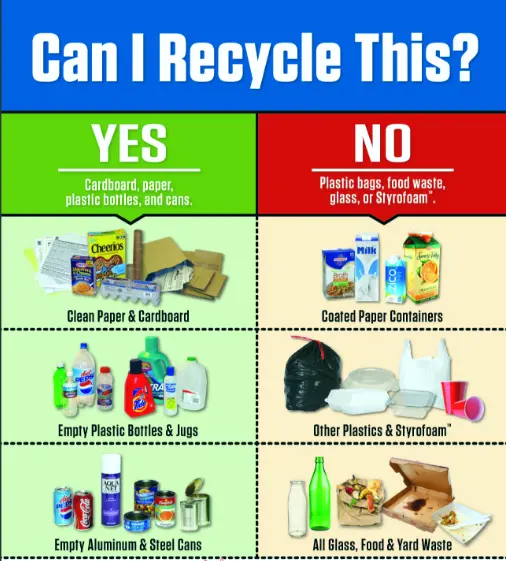
Now that you are familiar with recyclable materials, it is good to know non-recyclable materials as well. In the following, we introduce some of the most important non-recyclable materials:
- Shredded paper
Shredding paper reduces the length of its fibers and makes it inappropriate to reuse and recycle paper. - Glossy colored paper
Glossy colored paper will color the rest of the paper, which can ruin the entire paper load. - Pizza boxes
Important point: Pizza box is always known as non-recyclable cardboard waste. The pizza box is made of cardboard. But the pizza grease contaminates the cardboard. However, you can separate and recycle the clean cardboard sections. - The glass of the house
Products such as window frames, mirrors, lighting bulbs (light bulbs) and similar items cannot be recycled or reused. - Bottle caps
Bottle caps cannot be recycled with bottles. Because the bottle cap is made of different plastics. - Juice and milk cartons
Juice and milk cartons are usually covered with a thin layer of wax. That is why they are non-recyclable. - Paper cups
These cups have a plastic cover, so they are not recyclable.
What are the methods of separating and recycling recyclable materials in recycling centers?
The stages of waste separation are:
1- Separation of waste from the source
2- Collecting waste and transporting it to recycling centers
3- Separation of waste from each other
4- Washing and cleaning pollution and dirt from garbage
5- Changing the state and shape of waste and its ingredients in the recycling plant
6- Using recycled raw materials in industries
In general, material recycling is divided into three categories:
• The first category
recycling of materials that can be reused without any special process and only by washing, disinfecting and observing health issues; Like healthy glass bottles.
• The second category
recycling of materials that are transformed into new materials during some processes; such as broken glass, metals, plastic materials, paper, etc.
• The third category
Recycling of organic waste, such as turning perishable materials into compost or energy recovery.
Canadian recycling businesses
With the in-depth investigation we did regarding recycling, it is easy to see that Canada, with its large financial and economic resources and the high standard of living of the people, produces a lot of waste. Therefore, it is easy to understand that there are many companies active in this field and how much their turnover is.
Financial characteristics of the business sector in Canada
Canadian businesses in the waste management industry had total revenues of $8.2 billion in 2018, up from $7.7 billion in 2016.
Operating expenditures of the waste management industry were $6.5 billion in 2018. Capital investments related to waste management activities totaled $458 million in 2018, up 23% from 2016.
Financial characteristics of the government sector
Local governments spent $3.5 billion on waste management in 2018 and reported revenues of $2.9 billion from it.
Government expenditures related to the operation of waste diversion facilities reflect the growing demand for organics processing and recycling. From 2016 to 2018, local governments spent $364 million, an increase of 13% over that period, on the operation of organics and recycling facilities. Recent waste diversion data published from the biennial Waste Management Industry Survey indicate that municipalities across Canada diverted 9.8 million tons of waste from landfills in 2018. Furthermore, the latest Infrastructure Canada data reveal that the number of government-owned waste diversion facilities (1,532) surpassed the number of active disposal facilities (1,499) in 2018.
At the provincial level, Alberta’s expenditures related to the operation of organics facilities have risen 85% from 2016 to 2018. Similarly, Alberta saw an increase in the total amount of diverted organic waste in 2018, with just over 320 000 tons of organics diverted from disposal—an increase of over 80 000 tons since 2016.
Employment
Waste management activities in the public and private sectors provided employment for over 39,000 people across Canada in 2018. Full-time jobs represented 94% of all waste management-related jobs in 2018.
Sources:
33 Important Pros and Cons of Recycling – Green Coast
The Daily — Waste management industry: Financial information, 2018 (statcan.gc.ca)
#gainrecycling #gain #recyclingbusinesses #company #waste #wastemanagement #greentech #cleantech #canada #b2b #b2g #b2c